

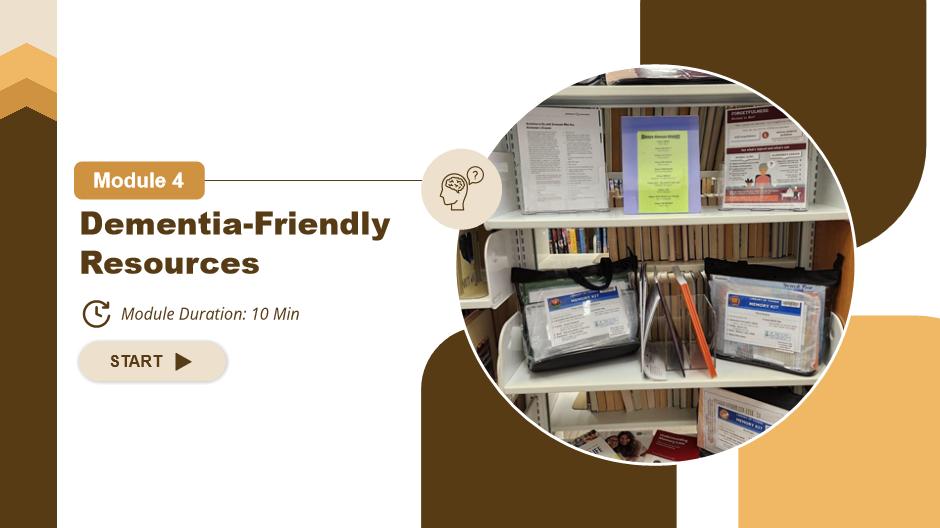
Module 4: Dementia-Friendly Resources

REACH Instructor
Course Overview
This course is designed to help library staff and volunteers build the knowledge, confidence, and practical skills needed to create a welcoming and supportive library experience for people living with dementia and their care partners. These modules build upon the Dementia-Friendly Library Guide and each reinforce a different aspect of dementia-friendly library service.
Module Description
Learn practical ways libraries can support people living with dementia and their care partners through books, resources, memory kits, community partnerships, presentations, and programs.
Please complete a brief survey (~3 minutes) at the end of the module to let us know what you thought, any changes you plan to make, and give feedback on how we could improve. This survey is the same for each module. You only need to complete the survey once.
What to Expect
Each module begins with instructions for navigating the training and includes interactive learning activities, case scenario videos, knowledge checks, and practical examples from library settings.
The modules are self-paced, allowing you to move through the material at a rate that works for you. Each module will take approximately 15 minutes to complete. Audio narration is available throughout the training for those who prefer to listen to the content.
As you progress, consider how the strategies and examples could be applied in your own library and community. Use the printable resources included in the Library Guide to take notes, reflect on key concepts, and identify ways to apply what you learn.
Acknowledgements
This training series was developed by the FSU REACH Program with instructional design led by Ramin Yazdanpanah, PhD, and content development by Nicolette Castagna, LMHC, MPH, CDP and LaVon Goodwin, MS. We gratefully acknowledge Lisa Granville, MD, Tiffaney Holcomb, MSW, and the Florida Division of Library and Information Services team for review and editing.
This resource is supported by the Health Resources and Services Administration (HRSA) of the U.S. Department of Health and Human Services (HHS) as part of an award totaling $1,000,000 with zero percentage financed with nongovernmental sources. The contents are those of the authors. They may not reflect the policies of HRSA, HHS, or the U.S. government.