

Section 2 of 6
Training, Communication & Understanding Dementia
Why Dementia-Friendly Training Matters
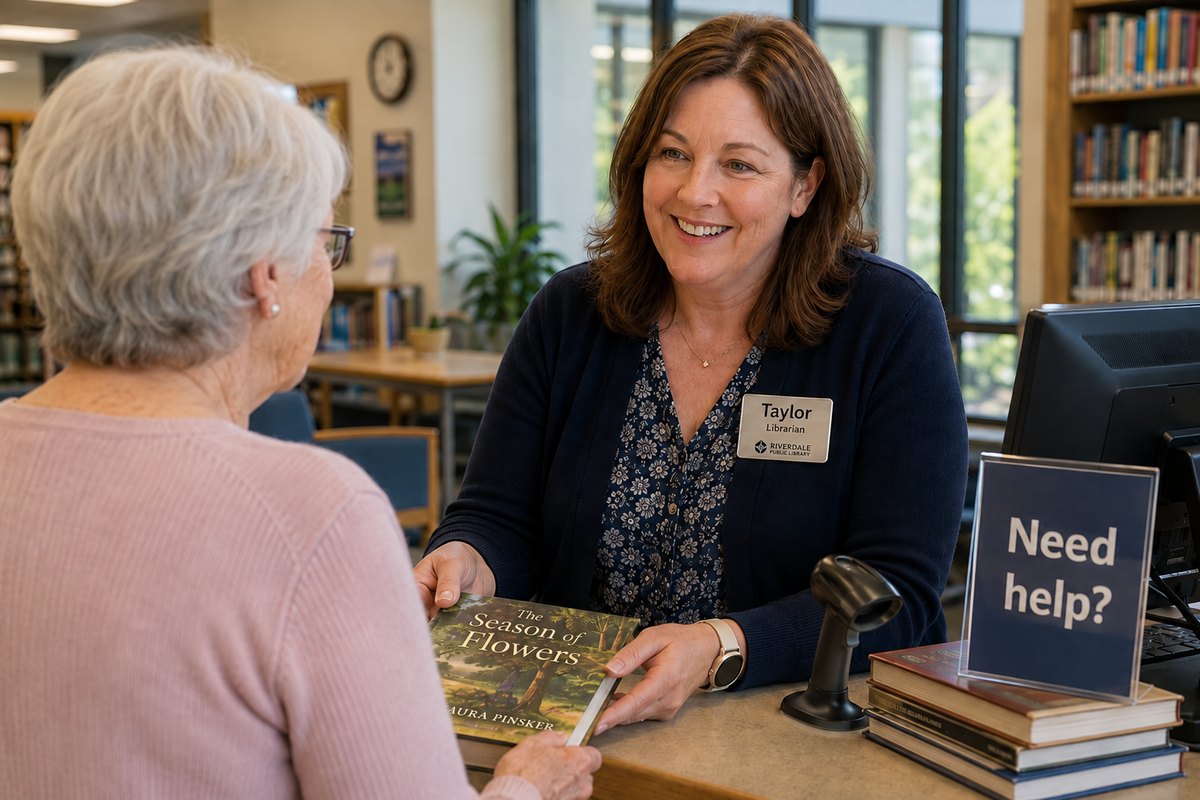
Libraries serve a large community of patrons, each with unique strengths, challenges, and goals. Some seek quiet study space. Others come for social connection, lifelong learning, or assistance accessing essential services.
Individuals living with dementia and cognitive impairments are part of this community. Their experiences may include changes in memory, communication, or navigation that influence how they interact with public spaces. Some visit independently. Others attend with a family member or care partner. Their needs may not always be visible, but they are present in every community.
Dementia-friendly practices strengthen a library’s ability to:
- Reduce confusion and distress
- Support independence and dignity
- Improve service interactions
- Respond effectively to emergent situations
- Reduce stigma and promote welcoming community spaces
Why Training Benefits Library Staff
Staff members are often among the first people to notice when patrons may be struggling with memory changes, confusion, or difficulty navigating their environment. Building foundational knowledge and practical strategies helps staff feel prepared and supported when serving patrons living with dementia.
Accommodations made for persons living with dementia often improve usability for many others, including individuals with disabilities, older adults, care partners, and anyone experiencing stress or information overload.
Dementia-friendly training benefits patrons and staff alike. When staff understand what may be happening and how to respond, interactions become more effective, less stressful, and more compassionate.
Understanding Dementia
What is Dementia?
Dementia is not a specific disease, but a term used to describe a group of symptoms that affect memory, thinking, communication, and daily functioning. These symptoms interfere with a person’s ability to complete everyday activities independently.
Dementia results from damage to or loss of nerve cells and their connections in the brain. Symptoms vary depending on which areas of the brain are affected. In a public setting such as a library, these changes may present as confusion, difficulty following directions, repeated questions, or challenges with communication.
Types of Dementia
| Type | Notes |
|---|---|
| Alzheimer’s disease | Most common type |
| Vascular dementia | Related to reduced blood flow to the brain |
| Dementia with Lewy bodies | Often includes visual hallucinations and movement symptoms |
| Frontotemporal dementia | Affects personality, behavior, and language |
| Parkinson’s disease-related dementia | Can develop as Parkinson’s disease progresses |
| Mixed dementia | More than one type of dementia-related condition present |
Dementia Is Not Normal Aging
Dementia is not a normal part of aging. While some mild changes in memory can occur with age, dementia involves significant cognitive decline that interferes with daily life and independence. Most dementias progress gradually over time. As the condition advances, the needs of individuals living with dementia, and those who support them, change and may become more complex.
Conditions That May Mimic Dementia
It is also important to recognize that certain medical conditions can mimic symptoms of dementia. Vitamin deficiencies, medication side effects, thyroid disorders, infections, and depression may cause memory or cognitive changes that resemble dementia. A thorough medical evaluation is essential when new or worsening cognitive symptoms are observed, as some causes may be treatable.
The role of library staff
Understanding these distinctions helps library staff recognize when a patron may need additional support, while also reinforcing that libraries are not responsible for diagnosis. The goal is not to identify a condition, but to recognize when someone may benefit from clearer communication, environmental adjustments, or additional assistance.
Recognizing Common Signs and Symptoms
Not every patron who shows one of these signs is living with dementia. Rather than focusing on identifying a condition, library staff can focus on responsive support by adjusting communication, simplifying choices, and offering assistance in ways that promote dignity and independence.
Symptoms vary widely between people and different types of dementia, but some of the most common signs include:
Memory Changes
Forgetting recent actions or conversations; repeating the same question or statement; misplacing items frequently.
Confusion with Time and Place
Losing track of the date or season; difficulty understanding where they are; becoming lost in familiar environments.
Communication Challenges
Difficulty finding the right words; trouble organizing thoughts; repeating familiar phrases.
Judgment or Decision-Making Changes
Becoming overwhelmed by multiple options; wearing clothing inappropriate for weather; difficulty completing multi-step tasks.
Mood or Personality Changes
Boredom, suspicion, anxiety, irritability, or emotional responses that do not fit the situation.
Visual and Spatial Changes
Difficulty judging distance or depth; trouble recognizing familiar places or faces; problems interpreting visual information (e.g., patterns, shadows, or reflective surfaces); difficulty navigating stairs, curbs, or changes in flooring.
Wandering in public spaces
Some individuals living with dementia may experience wandering or become disoriented in familiar environments. Many people living with dementia will wander at some point during the progression of the condition. In public spaces such as libraries, this may appear as pacing near entrances, searching for exits, asking repeatedly about going home, or having difficulty explaining where they intended to go.
Communication Best Practices
Individuals living with dementia may experience changes in memory, processing speed, communication, and sensory interpretation. Clear, supportive communication is the most effective tool for reducing confusion and promoting stability and positive outcomes.
Consider the following situation:
A patron approaches the circulation desk insisting that books were already returned. They repeat themselves and become visibly frustrated.
In moments like this, a staff member’s tone, posture, and word choice can either escalate or stabilize the interaction.
Verbal Communication
- Introduce yourself and provide context: “Hi, I’m Melissa. I work here at the library.” This introduction may need to be repeated during longer interactions.
- Address the person by their preferred name
- Use short, simple sentences
- Offer one instruction or question at a time
- Allow extra time for processing (up to 30 seconds)
- Speak slowly and clearly
- Write down key information if verbal communication becomes difficult
- Avoid arguing or correcting facts during moments of distress
Validation often reduces escalation more effectively than logic. Instead of correcting inaccuracies, staff can acknowledge feelings and redirect the patron gently.
Case Example: Responding with Validation
An older woman is standing alone in the Children and Youth Services section, appearing uncertain. A staff member approaches, introduces themselves, and asks if she needs assistance. She explains that she is looking for a book for her young daughter. Rather than correcting or making assumptions, the staff member responds: “That’s wonderful. What kinds of books does your daughter enjoy?” The staff member continues the conversation, helping her select an age-appropriate book based on the information she provided. The focus remains on supporting her stated goal in the moment. When appropriate, the staff member can gently redirect the interaction toward the immediate task, such as locating the book or reviewing checkout procedures.
Key point: Validation
Validation reduces distress and preserves dignity. The goal is not to correct or assume, but to support the person’s emotional reality and immediate need.
Nonverbal Communication
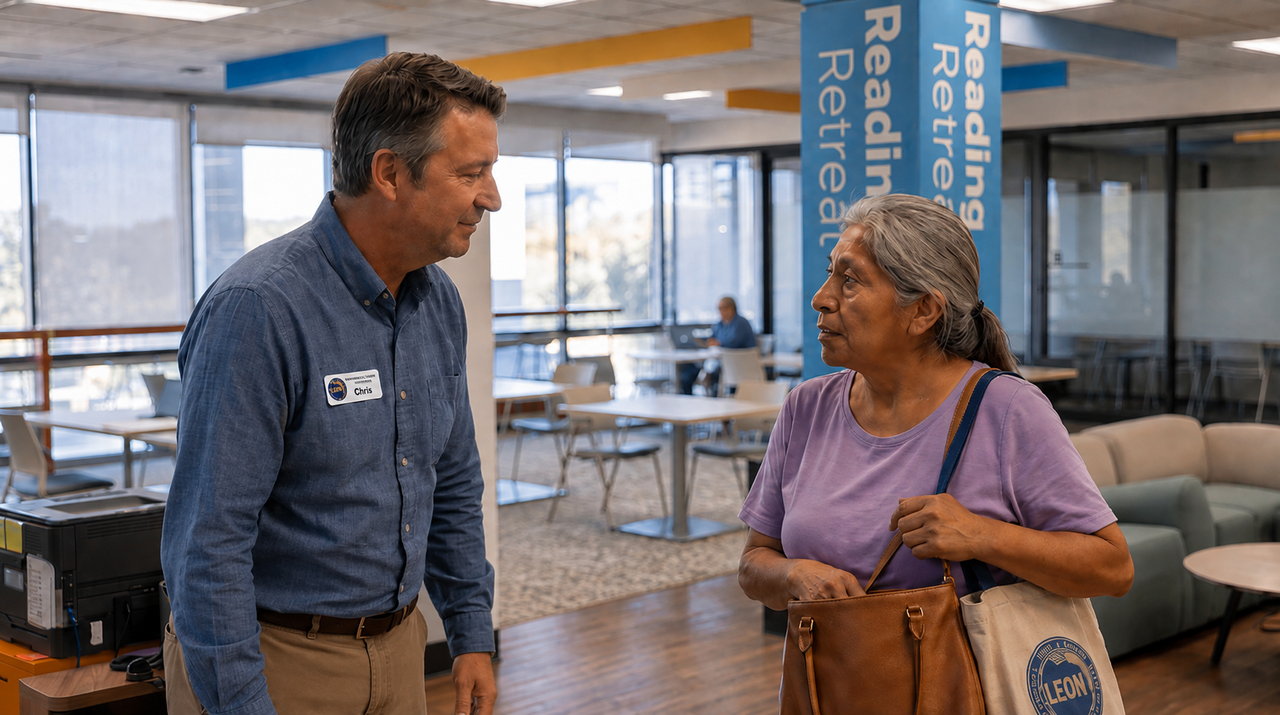
- Maintain some eye contact
- Face the person directly; avoid turning away or multitasking
- Position yourself at the person’s eye level when possible
- Keep body language open and calm
- Maintain a neutral, reassuring facial expression
- Use gestures to support verbal instructions
Even subtle shifts in posture, tone, and facial expression can influence whether an interaction escalates or stabilizes.
Responding to Challenging Situations
Most interactions with patrons living with dementia are positive and routine. However, memory changes, language difficulties, and sensory overload can sometimes create situations that may feel overwhelming. Difficult behaviors often reflect unmet human needs: safety, orientation, independence, connection, and relief from overstimulation. Awareness of unmet human needs shifts the goal from “correcting behavior” to “restoring stability.”
The REACH Approach
The REACH Approach is a simple framework that promotes readiness and safety when responding to escalating situations.
Risk Perception
Assess immediate safety for the patron, others, and yourself.
Establish Trust
Introduce yourself. Use a calm tone and open posture. Offer reassurance: “I’m here to help, let’s figure this out together.”
Assess Needs
Is the person lost? Searching for someone? Thirsty? Overstimulated? Identify the immediate need that may be contributing to distress. When assessing needs, also consider care partner needs and whether referral to community resources may be helpful once the situation stabilizes. Consider staff capacity to help and available resources.
Calm the Environment
Reduce sensory input. Move to a quieter or less crowded space. Offer a comfortable place to sit.
Healthy Partnerships
Know when to involve care partners, supervisors, or community organizations. This framework supports consistent, calm responses while preserving dignity.
Scenario 1 — Circulation Desk Interaction
Meet Ms. Rivera, an avid reader and regular library patron. Ms. Rivera approaches the desk holding several books but appears unsure why she is there. She sets the books down, picks them up again, and scans the area. She insists the books were already returned, repeating herself, and becomes visibly frustrated.
Rather than correcting her, the staff member lowers his voice, introduces himself, and steps from behind the desk to reduce pressure. He acknowledges her frustration and invites Ms. Rivera to sit in a quieter area.
Using short, simple questions and allowing extra time for her to respond, he works to clarify the situation. Together, they determine that different books may have been returned earlier. In the end, the issue is calmly resolved.
What worked well
- Recognized signs of confusion
- Lowered emotional intensity
- Validated feelings
- Reduced environmental stimulation
- Preserved dignity
Key takeaway
De-escalation begins with tone, positioning, and validation — not correction.
While some interactions involve confusion at service points, others may involve safety concerns that require additional assessment and coordination. The following example illustrates how communication skills and the REACH Approach apply when a patron appears disoriented or at risk.
Scenario 2 — Wandering
Meet Mr. Johnson, a regular patron of the library. Mr. Johnson is seen pacing near the entrance and appears anxious about “going home.” He is having trouble describing where home is and is worried his wife will be concerned.
Maya, a staff member, approaches calmly, offers reassurance, and invites Mr. Johnson to sit near the entrance while engaging in light conversation. Discreetly, Maya checks for a medical ID bracelet. She asks him simple questions. “Do you have a phone number for your wife?” Mr. Johnson shares a contact card.
Maya remains engaged while signaling another staff member discreetly and calmly to come over to her and Mr. Johnson per the libraries established safety protocol. Maya introduces Mr. Johnson to her colleague, Audrey, and explains that, “Audrey is going to give your wife Sarah a quick call so that she knows you are safe at the library.” He seems visually calmer and engaged.
Audrey lets Mrs. Johnson know her husband is safe at the library. When his wife arrives, Maya lets her know what happened. She is relieved and thanks the library staff for providing respectful support to her husband.
What worked well
- Recognized signs of disorientation
- Approached calmly without escalating anxiety
- Used simple, direct questions
- Followed established safety protocol
- Communicated clearly with the care partner
Why Wandering Matters
Wandering is one of the most common safety concerns associated with dementia. Many individuals living with dementia may leave familiar environments or become disoriented in public spaces.
Key takeaway
Staying calm, maintaining visibility, and following established safety protocols protects dignity while ensuring safety.
Staff and Volunteer Training Strategies
Dementia-friendly training does not need to be lengthy to be effective.
Foundational Awareness Training
All staff and volunteers should receive basic dementia-awareness education covering: what dementia is and is not; the role of library staff; recognizing common signs; communication best practices; responding to disorientation or distress; and review of internal safety procedures. Even brief sessions can significantly increase confidence and reduce uncertainty.
Scenario-Based Learning
Staff benefit from practical application through practice of de-escalation techniques, identifying communication missteps, reflecting on tone and body language, and discussing appropriate next steps. Scenarios may be delivered through in-person discussion, role-play exercises, case study review during staff meetings, or self-paced online modules.
Train-the-Trainer Model
Larger library systems may designate staff members to receive more in-depth training to serve as internal resource contacts, provide refresher sessions, support policy development, and assist with complex situations. This model promotes sustainability and reduces reliance on external facilitators over time. Libraries interested in expanding internal training capacity may also explore trainer certification opportunities through organizations such as the Alzheimer’s Association, Dementia Friendly America, and the National Council of Certified Dementia Practitioners.
Partner-Supported Training
Libraries are not expected to develop dementia expertise independently. Community partners can strengthen training efforts.
How Libraries Are Using This Model (2025 Survey Results)

Sarasota County Public Libraries
- Partnered with a local Dementia Care and Cure Initiative (DCCI) Task Force representative for dementia-specific staff training
- Incorporated dementia education into a systemwide staff development day
- Identified an internal “Dementia Champion” who delivers community-based programs such as the 10 Warning Signs of Alzheimer’s
Miami-Dade County
- Offered staff development sessions throughout the year
- Leadership and staff meet monthly to identify emerging training needs
- Engaged outside consultants for in-person and virtual training opportunities
These examples illustrate how libraries can combine community partnerships, internal champions, and ongoing staff development to strengthen dementia-friendly practices.
Community Partners to Consider
Many organizations already support dementia education, care partner services, and healthy aging initiatives. Libraries may consider partnering with the following groups when developing training, programs, or community outreach activities.
Potential partners include:
- Memory Disorder Clinics
- Geriatrics Workforce Enhancement Programs (GWEPs)
- State and Area Agencies on Aging
- Alzheimer’s Association chapters
- Academic health centers
These organizations may provide guest speakers, educational materials, consultation, or co-facilitated training sessions.
Ongoing Reinforcement
Dementia-friendly practices are strengthened through repetition and reinforcement. Consider:
- Brief refresher discussions during staff meetings
- Periodic review of safety protocols
- Case reviews in team conversations
- Sharing updates from community partners
- Dementia-friendly job aid handouts for staff
Short, consistent reminders help normalize best practices and reduce anxiety when situations arise.
Volunteer Considerations
Volunteers may interact with patrons in programs, service desks, or outreach events. Training for volunteers should be tailored to their role and include:
- Basic dementia awareness
- Communication best practices
- Clear instructions on when to notify staff
- Understanding of boundaries and confidentiality
Providing volunteers with simple guidance supports safe and respectful interactions.
Dementia-Friendly Training Readiness Checklist
Does your library:
Download Checklist (fillable PDF)
From knowledge to action
Begin with small, manageable steps. Identify one communication practice to reinforce during team meetings. Connect with one local aging-services partner. Encourage staff to complete the FSU REACH dementia-friendly library training module. Dementia-friendly service is an ongoing commitment to clarity, dignity, and community participation.